An Indictment Report on Climate Destruction, Mass Harm, and Command Responsibility
Preamble
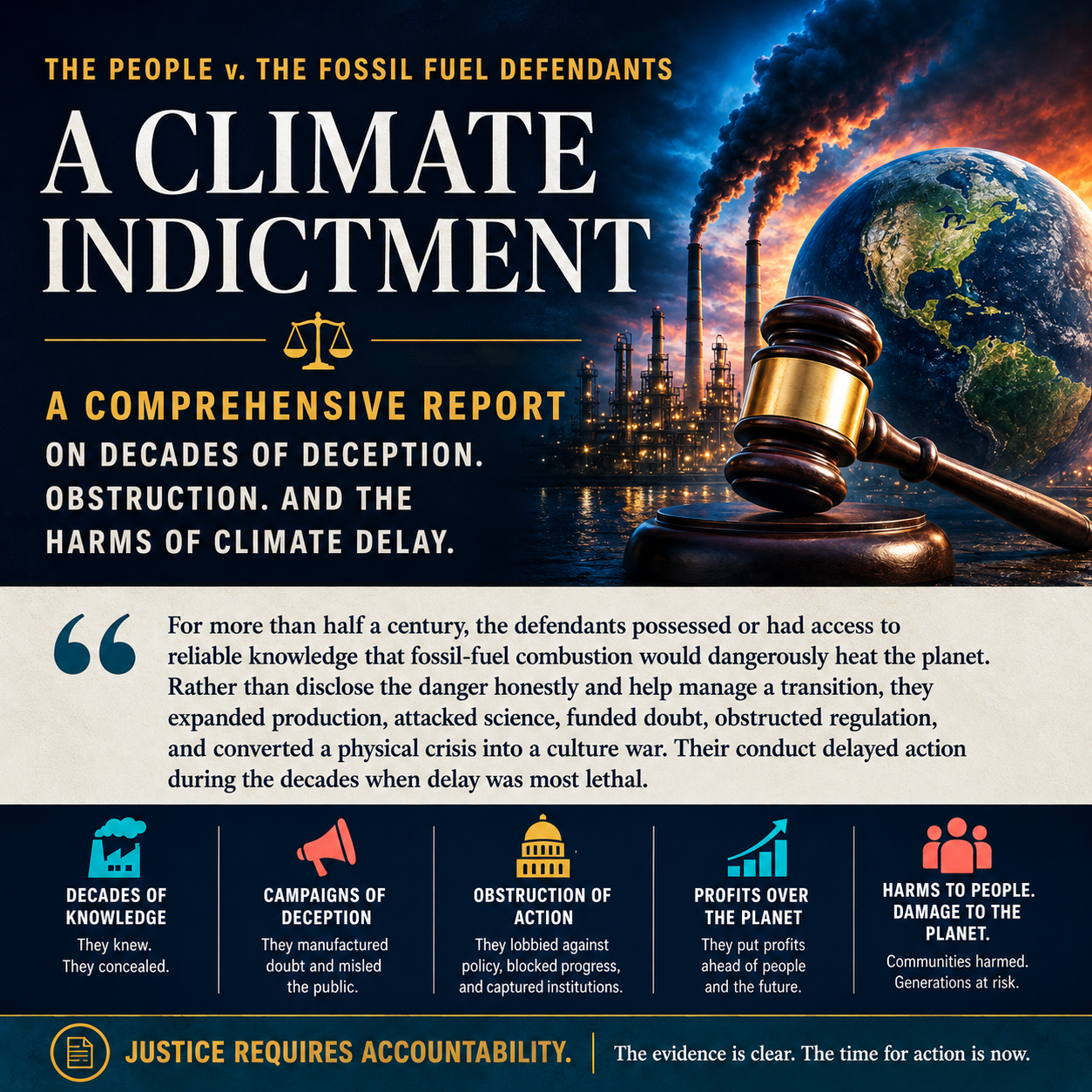
For more than half a century, the defendants possessed or had access to reliable knowledge that fossil-fuel combustion would dangerously heat the planet. Rather than disclose the danger honestly and help manage a transition, they expanded production, attacked science, funded doubt, obstructed regulation, and converted a physical crisis into a culture war. Their conduct delayed action during the decades when delay was most lethal.
This report is written in the style of a tribunal indictment. It does not claim that any named person or entity has been convicted by an actual criminal court. It sets out a hypothetical prosecutorial theory: that certain fossil-fuel executives, state oil commands, political leaders, trade associations, public-relations firms, and media figures would face charges before a court designed to judge planet-scale harm.
The analogy to postwar tribunals is used for form: command responsibility, knowledge, organized deception, accessory liability, and sentencing. The analogy is not an equivalence between historical crimes. The point is narrower and colder. When a system of harm is large enough, the law cannot stop with the person holding the shovel. It must ask who wrote the plan, who hid the warning, who paid for the lie, who gave the orders, who supplied the respectable language, and who kept the public too confused to escape.
I. Summary of Findings
The tribunal finds probable cause to charge a coordinated fossil-fuel deception and delay enterprise with crimes against humanity, crimes against nature, reckless endangerment of future generations, and organized obstruction of planetary rescue.
The strongest case is not against ordinary consumers, refinery workers, drillers, pipefitters, gas-station attendants, or families trying to keep the lights on. The strongest case lies with the command layer: those who knew, those who had the power to act, those who profited from inaction, and those who deliberately polluted the public mind.
The evidence divides into five broad categories.
First, major fossil-fuel companies possessed early and reliable knowledge that fossil-fuel combustion would heat the planet. Exxon’s internal scientific projections from the late twentieth century closely matched later observed warming. Shell’s 1988 internal report described the greenhouse effect, sea-level rise, ocean acidification, and human migration pressures. Total and Elf received warnings as early as 1971 that their products could drive dangerous warming.
Second, the industry continued to expand production after internal knowledge was no longer reasonably deniable. Carbon Majors data trace 1,436 GtCO₂e of cumulative historical emissions from 1854 through 2024 to 178 industrial producers. In 2024 alone, 166 active entities were linked to 34.7 GtCO₂e, roughly 80 percent of global fossil-fuel and cement CO₂ emissions. A small number of state-owned and investor-owned entities dominate this burden.
Third, industry trade groups and allied political organizations manufactured doubt. The American Petroleum Institute’s 1998 climate communications plan aimed to make the public recognize “uncertainties” in climate science. The Global Climate Coalition, API, and allied organizations translated industry anxiety into lobbying, talking points, pseudo-scientific controversy, and delay.
Fourth, political actors turned delay into law. In the United States, Donald J. Trump stands as the highest modern political defendant because he acted after the science was settled and after clean-energy technologies were viable. His administration rolled back climate rules, attacked wind and electric vehicles, repealed the EPA endangerment finding, and told a global audience that climate change was a “con job.” Earlier political defendants, including George W. Bush, Dick Cheney, and James Inhofe, helped embed climate rejection in American governance.
Fifth, media and public-relations actors converted a technical emergency into tribal identity. The role of public-relations firms, advertising agencies, think tanks, cable personalities, and talk-radio hosts was not merely to “express opinion.” The alleged offense is professional assistance in making the public less able to understand an unfolding danger.
The tribunal’s sentencing framework treats guilt as a combination of knowledge, power, intent, reach, profit, and harm. The highest tier, A+, applies to actors with command authority, clear knowledge, global impact, and organized deception or obstruction. The proposed sentence for conviction at that level is life imprisonment, or forty years to life, along with asset seizure for climate repair. Lower tiers range from civil penalties and transition orders to prison terms of five to forty years.
II. Theory of Liability
The prosecution does not charge the mere existence of fossil fuels. Nor does it charge the use of energy by ordinary people in societies built around oil, gas, and coal. The charge is more specific.
The defendants are alleged to have participated in one or more of the following:
- Continuing to expand fossil-fuel production after learning that the product would destabilize the climate.
- Suppressing, softening, or contradicting internal scientific knowledge.
- Financing public doubt after the private evidence showed danger.
- Lobbying against regulation while presenting themselves as responsible climate actors.
- Turning climate science into a culture-war weapon.
- Delaying the energy transition during the period when early action would have prevented the worst damage.
- Protecting profits while shifting heat, flood, famine, disease, displacement, extinction, and cleanup costs onto the public.
The standard is not perfection. No leader in 1965 could have instantly replaced the global energy system. The standard is what a reasonable, powerful actor did after receiving credible warning. Did the actor disclose? Did the actor reduce harm? Did the actor prepare transition? Did the actor warn consumers and governments? Or did the actor protect the machine and attack the alarm bell?
The prosecution argues that the defendants chose the latter.
III. The Harm
The harms charged are human, animal, ecological, economic, and intergenerational.
Human harms include heat deaths, air-pollution deaths, hunger, disease expansion, disaster deaths, occupational heat injury, migration pressure, mental-health injury, and increased mortality among the elderly, poor, outdoor workers, children, and people in countries least responsible for historical emissions.
Animal and ecosystem harms include coral bleaching, marine heat waves, collapsing habitats, wildfire mortality, heat-driven die-offs, ocean acidification, drought stress, polar habitat loss, and the broader thinning of the living world. The tribunal recognizes that ecosystems do not testify, file lawsuits, or hire counsel. That silence is part of the crime scene.
The report uses three harm measures.
The first is producer-linked emissions. Carbon Majors provides entity-level emissions data for fossil-fuel and cement producers. This is the closest thing to a defendant roster written in atmospheric carbon.
The second is mortality modeling. Bressler’s mortality cost of carbon estimates that 4,434 metric tons of CO₂ emitted in 2020 causes one expected excess heat-related death by 2100. That converts to about 226 expected excess deaths per million metric tons of CO₂. This is not an autopsy list. It is a model of probabilistic mortality risk.
The third is delay responsibility. Some actors, such as PR firms, politicians, and broadcasters, do not have direct production emissions. Their damage lies in delay. For them, the tribunal assigns qualitative death brackets: thousands, tens of thousands, hundreds of thousands, or millions of delay-linked deaths, depending on reach, duration, and command role.
IV. Sentencing Scale
A+ — First-Dock Command Liability
Standard: Clear knowledge, executive or state power, global reach, organized deception or obstruction, and immense damage.
Proposed sentence: Life imprisonment, or 40 years to life.
Civil penalty: Asset seizure, corporate breakup where applicable, full participation in climate repair funds, permanent ban from energy governance or public communications concerning climate.
A — High-Command Liability
Standard: Large-scale emissions or obstruction, strong evidence of knowledge, command responsibility, and prolonged delay.
Proposed sentence: 30 to 40 years.
Civil penalty: Reparations, forced phaseout, public document archive, damages fund.
A- — Senior Accomplice Liability
Standard: Major executive, political, media, lobbying, or state role; lower direct control than A+ defendants or less complete deception record.
Proposed sentence: 20 to 30 years.
B+ — Operational Propaganda or Policy Liability
Standard: Repeated participation in delay campaigns, policy rollback, front-group work, or public disinformation.
Proposed sentence: 12 to 20 years.
B — Amplifier Liability
Standard: Major public influence used to normalize denial or delay, without direct command over production.
Proposed sentence: 5 to 12 years.
C — Production Liability Without Strong Deception Record
Standard: High emissions but weaker evidence of fraud, often in state-development contexts.
Proposed sentence: Civil penalties to 8 years, with transition obligations favored over imprisonment.
CHAPTER ONE
The Corporate Knowledge Case
ExxonMobil
ExxonMobil is the central corporate defendant because its internal scientific record is unusually strong. Exxon scientists projected warming with striking accuracy, while later public-facing messaging challenged the reliability of climate models and the certainty of climate science.
The tribunal would place Raymond-era ExxonMobil leadership in the first dock. Lee Raymond’s tenure represents the moment when knowledge, money, industry coordination, and political influence converged. The company had the capacity to warn the world and help design a managed transition. Instead, Exxon became one of the clearest examples of institutional delay.
Tribunal grade: A+
Proposed sentence for responsible living executives, if convicted: Life, or 40 years to life.
2024 producer-linked emissions: 677 MtCO₂e.
Rough expected excess heat deaths from 2024 production alone: about 153,000 by 2100, using the mortality-cost method as a rough proxy.
Historical emissions: 57.458 GtCO₂e from 1854 through 2024.
Core charge: Knowledge plus deception plus continued expansion.
Chevron
Chevron’s case rests on scale, industry role, litigation history, and trade-association participation. The evidence of internal climate modeling is less iconic than Exxon’s, but the production burden is enormous.
Tribunal grade: A
Proposed sentence: 35 to 40 years.
2024 producer-linked emissions: 577 MtCO₂e.
Rough expected excess heat deaths from 2024 production alone: about 130,000.
Historical emissions: 62.503 GtCO₂e.
Core charge: High-volume production, delay lobbying, and participation in the supermajor defense of fossil-fuel expansion.
Shell
Shell’s 1988 internal report makes the case unusually clear. The company described the greenhouse effect, recognized fossil fuels’ role, and considered future harms including sea-level rise, ocean acidification, and migration. The warning was not vague smoke from a distant fire. It was a map.
Tribunal grade: A
Proposed sentence: 30 to 40 years.
2024 producer-linked emissions: 426 MtCO₂e.
Rough expected excess heat deaths from 2024 production alone: about 96,000.
Historical emissions: 41.517 GtCO₂e.
Core charge: Internal warning followed by continued production and delayed transition.
BP
BP’s public image often looked more climate-modern than Exxon’s, but image is not acquittal. The tribunal would examine whether BP’s branding, lobbying, trade-association ties, and production plans helped preserve the fossil-fuel system while appearing to accept climate reality.
Tribunal grade: A-
Proposed sentence: 20 to 30 years.
2024 producer-linked emissions: 354 MtCO₂e.
Rough expected excess heat deaths from 2024 production alone: about 80,000.
Historical emissions: 43.231 GtCO₂e.
Core charge: Major production and delay under a more polished public face.
TotalEnergies / Elf
The French case is one of the strongest because the knowledge timeline reaches back to 1971. Researchers have documented that Total and Elf personnel received early warnings, later became more fully informed, then shifted through silence, doubt, and partial acceptance while protecting the business model.
Tribunal grade: A
Proposed sentence: 30 to 40 years.
2024 producer-linked emissions: 352 MtCO₂e.
Rough expected excess heat deaths from 2024 production alone: about 80,000.
Historical emissions: 18.572 GtCO₂e.
Core charge: Early warning, delayed public honesty, and continued fossil-fuel defense.
CHAPTER TWO
The Trade-Association and Organized Doubt Case
American Petroleum Institute
The American Petroleum Institute would be charged as an operational command center for public confusion. Its 1998 climate communications plan was not the work of a lone crank with a newsletter. It was a strategic program developed after the Kyoto Protocol, aimed at shaping what the public and policymakers understood about climate science.
The goal was not to discover truth. The goal was to keep uncertainty alive as a political tool.
Tribunal grade: A
Proposed sentence for responsible strategists, if convicted: 30 to 40 years.
Damage estimate: Unquantified direct emissions; very high delay damage.
Death bracket: Hundreds of thousands to millions of delay-linked deaths if the tribunal finds that API’s work materially delayed national and global policy.
Core charge: Organized manufacture of doubt.
Global Climate Coalition
The Global Climate Coalition would be charged as a corporate front of delay. It contested climate policy, fought binding emissions limits, and helped industry members speak through a collective shield. Its name sounded boring enough to put a person to sleep, which was part of the genius. Bureaucratic names make excellent hiding places.
Tribunal grade: A
Proposed sentence: 30 to 40 years for top responsible figures.
Damage estimate: Delay and obstruction rather than direct production.
Death bracket: Hundreds of thousands to millions of delay-linked deaths.
Core charge: Coordinated obstruction of early climate policy.
Koch Political Network
Charles Koch and the Koch network would be charged as financiers and architects of climate-policy paralysis. The case is not simply that Koch-related businesses profited from fossil fuels. The case is that Koch-linked funding helped turn climate action into ideological poison within American conservatism.
David Koch, now deceased, could not be imprisoned. A tribunal could still issue a posthumous finding and attach assets, foundations, archives, or institutional successors to civil remedies.
Tribunal grade: A+
Proposed sentence for responsible living principals: Life, or 40 years to life.
Damage estimate: Political delay at national and global scale.
Death bracket: Hundreds of thousands to millions of delay-linked deaths.
Core charge: Financing the long war against climate action.
CHAPTER THREE
The Political Command Case
Donald J. Trump
Donald J. Trump is the highest-ranking modern political defendant in this report. He did not invent climate denial. His liability is worse in one respect: he acted after the factual dispute was over.
By the time Trump returned to office, climate science was settled enough for responsible governance. Clean energy had become cheaper and more practical. The damage record was visible in fires, floods, heat deaths, insurance collapse, drought, migration pressure, and coastal risk. Yet Trump used executive power to obstruct the transition, cancel clean-energy support, attack wind power, promote fossil fuels, and repeal the EPA endangerment finding.
His public rhetoric matters because presidential speech is not ordinary speech. When a president calls climate change a “con job,” the statement becomes permission: permission to ignore science, mock expertise, block transition, and treat planetary risk as tribal insult.
Tribunal grade: A+
Proposed sentence: 40 years to life.
Damage estimate: Carbon Brief estimated that a second Trump term could add 4 GtCO₂e to U.S. emissions by 2030 compared with Biden-era policy.
Rough death estimate: About 900,000 expected excess heat deaths by 2100 if that 4 GtCO₂e estimate is converted using the mortality-cost method.
Core charge: Knowing political sabotage of climate action after the danger was settled.
George W. Bush and Dick Cheney
The Bush-Cheney administration belongs in the earlier political-obstruction chapter. Its rejection of Kyoto-era climate obligations and fossil-centered energy politics helped squander years when the transition could have been cheaper, calmer, and less culturally poisoned.
Tribunal grade: B+ to A-
Proposed sentence: 15 to 25 years.
Damage estimate: Delay during a crucial policy window.
Death bracket: Tens of thousands to hundreds of thousands of delay-linked deaths.
Core charge: Federal obstruction and industry-aligned delay.
James Inhofe
James Inhofe transformed climate denial into Senate theater. His snowball stunt became a perfect artifact of policy collapse: a small theatrical object used to mock planetary physics. Inhofe’s liability is not that he was ignorant. It is that he used public authority to make ignorance contagious.
Tribunal grade: B+ to A-
Proposed sentence: 15 to 25 years.
Damage estimate: Legislative obstruction and normalization of denial.
Death bracket: Tens of thousands to hundreds of thousands of delay-linked deaths.
Core charge: Public-office amplification of false doubt.
CHAPTER FOUR
The Petrostate Command Case
Saudi Arabia / Saudi Aramco
Saudi Aramco is one of the clearest first-dock defendants by production scale. The company is not merely a business. It is a pillar of state power. Saudi oil policy, climate diplomacy, and production expansion have defended the central product category driving the emergency.
Tribunal grade: A+
Proposed sentence: Life, or 40 years to life for responsible living command figures.
2024 producer-linked emissions: 1,786 MtCO₂e.
Rough expected excess heat deaths from 2024 production alone: about 404,000.
Historical emissions: 72.457 GtCO₂e.
Core charge: State-command extraction and diplomatic obstruction after knowledge.
Russia / Gazprom and Rosneft
Russia’s case differs from Exxon’s. The prosecution would have less need to prove a consumer deception campaign and more need to prove state-command extraction, fossil-fuel geopolitical leverage, and obstruction of global climate progress.
Gazprom’s production burden alone places it among the highest-priority defendants. Rosneft adds oil-sector weight to the state fossil system.
Gazprom grade: A
Proposed sentence: 30 to 40 years.
2024 producer-linked emissions: 1,293 MtCO₂e.
Rough expected excess heat deaths from 2024 production alone: about 292,000.
Historical emissions: 53.116 GtCO₂e.
Core charge: State fossil extraction and obstruction.
Rosneft grade: A-
Proposed sentence: 25 to 30 years.
2024 producer-linked emissions: 763 MtCO₂e.
Rough expected excess heat deaths from 2024 production alone: about 172,000.
Core charge: High-volume extraction within a petrostate system.
United Arab Emirates / ADNOC
ADNOC would be charged as a modern petrostate producer whose public climate diplomacy must be weighed against continuing production. The tribunal would pay special attention to the gap between climate language and extraction plans.
Tribunal grade: A-
Proposed sentence: 20 to 30 years.
2024 producer-linked emissions: 622 MtCO₂e.
Rough expected excess heat deaths from 2024 production alone: about 141,000.
Historical emissions: 18.480 GtCO₂e.
Core charge: Modern petrostate expansion under climate-aware branding.
Iran, Iraq, Qatar, Kuwait, Algeria, Mexico, Brazil, Venezuela, Nigeria
These producers belong in a second petrostate annex. Their production footprints are large. Their culpability would vary by evidence of deception, wealth, capacity to transition, dependence on oil revenue, and conduct in climate diplomacy.
National Iranian Oil Company: A for physical damage; B for deception unless stronger evidence is shown. 2024 emissions of 1,387 MtCO₂e; rough expected deaths from 2024 production: about 313,000.
Iraq National Oil Company: B+ to A-. 2024 emissions of 549 MtCO₂e; rough expected deaths: about 124,000.
QatarEnergy: B+ to A-. 2024 emissions of 446 MtCO₂e; rough expected deaths: about 101,000.
Kuwait Petroleum Corp.: B+ to A-. 2024 emissions of 419 MtCO₂e; rough expected deaths: about 95,000.
Sonatrach, Algeria: B+ to A-. 2024 emissions of 576 MtCO₂e; rough expected deaths: about 130,000.
Pemex, Mexico: B+ to A-. 2024 emissions of 378 MtCO₂e; rough expected deaths: about 85,000.
Petrobras, Brazil: B. 2024 emissions of 400 MtCO₂e; rough expected deaths: about 90,000.
Petróleos de Venezuela: B. 2024 emissions of 192 MtCO₂e; rough expected deaths: about 43,000.
Nigerian National Petroleum Corp.: B. 2024 emissions of 337 MtCO₂e; rough expected deaths: about 76,000.
CHAPTER FIVE
The Coal Command Case: China and India
China: CHN Energy, CNPC, and State Coal Command
China presents a hard legal question. The physical damage is vast. The deception case, as currently available in public evidence, is different from the Exxon-Shell-API model.
Chinese coal has helped drive modern warming. CHN Energy’s 2024 producer-linked emissions were nearly as large as Saudi Aramco’s. Chinese state-linked coal entities appear throughout the top ranks of Carbon Majors. Yet a fair tribunal must separate production harm from a specific deception charge. The Western supermajor case is strongest where internal documents, public contradiction, and organized doubt campaigns line up. In China, the strongest charge is state-command emissions after knowledge, not the same consumer-fraud pattern.
CHN Energy grade: A for physical damage; C to B for deception unless stronger proof is produced.
Proposed sentence: 8 to 25 years, depending on proof of knowing obstruction or fraud.
2024 producer-linked emissions: 1,679 MtCO₂e.
Rough expected excess heat deaths from 2024 production alone: about 379,000.
Core charge: High-volume coal production after knowledge.
CNPC grade: B+ to A-.
Proposed sentence: 15 to 30 years.
2024 producer-linked emissions: 750 MtCO₂e.
Rough expected deaths from 2024 production alone: about 170,000.
Core charge: Large-scale production by a state-linked oil and gas actor.
India: Coal India
Coal India is another difficult case. Its production burden is enormous. Its moral and legal standing is different from that of rich industrial countries and private oil majors that profited for generations while financing doubt. India has real energy-poverty and development arguments. Those arguments do not erase harm, but they affect sentencing.
Coal India grade: A for physical damage; C to B for deception.
Proposed sentence: 5 to 20 years, with reparations and forced transition favored over long imprisonment unless deception is proven.
2024 producer-linked emissions: 1,684 MtCO₂e.
Rough expected excess heat deaths from 2024 production alone: about 381,000.
Historical emissions: 35.221 GtCO₂e.
Core charge: Massive coal production after knowledge, tempered by development context.
CHAPTER SIX
The Media, Public-Relations, and Advertising Case
Rupert Murdoch, News Corp, Fox News, and the Climate-Denial Media System
Rupert Murdoch and the Fox-News-linked media system would not be charged as fossil-fuel producers. The charge would be more subtle and, in some ways, more corrosive: training millions of people to interpret climate science as political humiliation.
The tribunal would ask whether climate denial and delay were treated as an editorial product. Did the media system repeatedly elevate doubt over evidence? Did it ridicule scientists? Did it convert clean energy into a masculinity panic, an elitist plot, or a foreign conspiracy? Did it help politicians survive by making inaction emotionally satisfying to their audience?
Tribunal grade: A- for propaganda reach; B for direct legal culpability unless coordination is proven.
Proposed sentence: 12 to 25 years if knowing disinformation is proven.
Damage estimate: No direct emissions; high epistemic damage.
Death bracket: Tens of thousands to hundreds of thousands of delay-linked deaths.
Core charge: Mass amplification of climate denial and delay.
Talk Radio and Cable Personalities
The tribunal would treat the most influential talk-radio and cable personalities as lower-command propaganda actors. Rush Limbaugh, Sean Hannity, Tucker Carlson, Laura Ingraham, and similar figures did not run Exxon, write the API plan, or operate Saudi Aramco. Their alleged role was to make the lie enjoyable.
That matters. Propaganda works best when it becomes a mood. A voter does not need to read a white paper if a host has already taught him to smirk.
Tribunal grade: B
Proposed sentence: 5 to 12 years.
Damage estimate: Cultural delay and disinformation.
Death bracket: Thousands to hundreds of thousands, depending on demonstrable reach and coordination.
Core charge: Mass amplification of denial and ridicule.
Public-Relations and Advertising Firms
The tribunal would charge selected executives and firms only where evidence shows knowing assistance in deception, greenwashing, or delay. The target would not be every junior copywriter who wrote “lower carbon future” on a Tuesday afternoon. The target would be leadership that accepted fossil-fuel money while knowing the campaign’s function was to protect continued extraction.
Firms such as Edelman, FTI Consulting, WPP, Omnicom, IPG, Publicis, Havas, Dentsu, and other fossil-fuel advertising and PR networks would be reviewed contract by contract. The question would be: did the work help the public understand reality, or did it give a dangerous industry a better costume?
Tribunal grade: B+ to A- for knowing senior executives.
Proposed sentence: 12 to 25 years.
Damage estimate: Delay, greenwashing, and preserved social license.
Death bracket: Tens of thousands to hundreds of thousands of delay-linked deaths.
Core charge: Professional assistance to deception.
CHAPTER SEVEN
Australia and Canada
Australia: Tony Abbott, Scott Morrison, and Fossil-Fuel Political Theater
Australia’s climate defendants illustrate the power of symbolic politics. Tony Abbott’s repeal of Australia’s carbon price and Scott Morrison’s coal-lump theatrics did not merely change policy. They taught the public that climate seriousness could be treated as a joke.
Tony Abbott grade: B+
Proposed sentence: 12 to 20 years.
Damage estimate: Carbon-price repeal and policy delay.
Death bracket: Thousands to tens of thousands of delay-linked deaths.
Core charge: Political rollback.
Scott Morrison grade: B
Proposed sentence: 5 to 12 years.
Damage estimate: Normalization of coal politics and delay.
Death bracket: Thousands to tens of thousands.
Core charge: Fossil-fuel political theater.
Canada: Stephen Harper and Oil-Sands Leadership
Canada’s case is the case of a wealthy democracy that knew better and moved slowly. Stephen Harper’s government withdrew from Kyoto, and Canadian oil-sands leadership continued defending high-carbon production through public messaging and political influence.
Stephen Harper grade: B+
Proposed sentence: 12 to 20 years.
Damage estimate: National retreat from climate obligations.
Death bracket: Thousands to tens of thousands.
Core charge: Wealthy-state obstruction.
Canadian oil-sands leadership grade: B+ to A-
Proposed sentence: 15 to 25 years.
Damage estimate: High-carbon extraction and reputational defense.
Death bracket: Tens of thousands where production and greenwashing are proven.
Core charge: High-carbon production under responsible-sounding branding.
CHAPTER EIGHT
The Supermajor Joint Enterprise
The five-supermajor case—ExxonMobil, Chevron, Shell, BP, and TotalEnergies—would be charged as a joint enterprise of knowledge, production, lobbying, and delay. The companies differed in tone. Exxon looked combative. BP looked polished. Shell looked technocratic. Total looked European and controlled. Chevron looked lawyered-up and permanent.
But the atmosphere does not care about branding. Carbon dioxide does not read annual reports. Methane does not pause for a sustainability video.
Global Witness estimated that the planned oil and gas production of Shell, BP, TotalEnergies, ExxonMobil, and Chevron through 2050 could cause 11.5 million additional premature heat deaths before 2100. This estimate is not a criminal verdict, but it gives the tribunal a moral scale: future production plans are not abstractions. They are body-count forecasts.
Tribunal grade: A+
Proposed sentence for responsible command figures: Life, or 40 years to life.
2024 collective emissions for the top investor-owned companies: about 2.4 GtCO₂e for the top five investor-owned emitters.
Rough expected excess heat deaths from 2024 production alone: more than half a million.
Future heat-death estimate from planned production: 11.5 million, using Global Witness’s analysis.
Core charge: The corporate heart of climate delay.
CHAPTER NINE
Findings by Nationality
United States
The United States produces the deepest deception record. Its defendants include ExxonMobil, Chevron, API, the Global Climate Coalition, the Koch network, Donald Trump, George W. Bush, Dick Cheney, James Inhofe, conservative think tanks, cable hosts, talk-radio personalities, and fossil-fuel PR firms.
The prosecution’s U.S. theory is simple: the country that had some of the best science, the richest firms, the strongest universities, and the largest media system also produced the most durable denial machine.
Highest U.S. defendants: ExxonMobil leadership, API/GCC strategists, Koch network principals, Donald Trump, Chevron leadership.
Sentence range: B to A+, with life sentences reserved for command figures.
Saudi Arabia
Saudi Arabia’s case is state-command production and diplomatic obstruction. Saudi Aramco’s emissions place it among the first-dock defendants.
Highest Saudi defendant: Saudi Aramco and state oil command.
Sentence range: A+.
Russia
Russia’s case is petrostate extraction and fossil-fuel geopolitical power. Gazprom and Rosneft would face high-command charges.
Highest Russian defendants: Gazprom, Rosneft, Putin-era fossil-state command.
Sentence range: A- to A.
China
China’s case is physically enormous and legally more complex. The coal damage is immense. The deception case requires more specific evidence.
Highest Chinese defendants: CHN Energy, CNPC, state coal command.
Sentence range: C to A, depending on charge.
India
India’s case is coal-heavy but morally complicated by development and energy poverty.
Highest Indian defendant: Coal India.
Sentence range: C to B for deception; A for physical emissions.
United Kingdom / Netherlands
The Shell and BP cases would lead this chapter. Shell’s internal-document record is especially strong.
Highest defendants: Shell high command, BP leadership, fossil-fuel advertising networks.
Sentence range: A- to A.
France
TotalEnergies and Elf would face a strong early-knowledge case.
Highest defendant: TotalEnergies / Elf leadership.
Sentence range: A.
United Arab Emirates
The UAE’s case rests on ADNOC’s production scale and petrostate climate diplomacy.
Highest defendant: ADNOC and UAE fossil leadership.
Sentence range: A-.
Australia
Australia’s case centers on media and politics: Murdoch-linked media, Abbott, Morrison, and coal culture.
Highest defendants: Rupert Murdoch / News Corp command layer if knowing disinformation is proven; Tony Abbott; Scott Morrison.
Sentence range: B to A-.
Canada
Canada’s case focuses on Kyoto withdrawal, oil sands, and high-capacity delay.
Highest defendants: Stephen Harper; Canadian oil-sands leadership.
Sentence range: B+ to A-.
CHAPTER TEN
Who Is Not in the Dock
The tribunal expressly excludes ordinary consumers. The modern world was built around fossil fuel, often without meaningful alternatives. A person driving to work in a used truck is not in the same moral category as an executive suppressing climate risk or a president dismantling climate law.
Most fossil-fuel workers are also excluded. A pipefitter did not write the API plan. A refinery employee did not decide to mislead the public. A roughneck did not command global lobbying strategy. Workers may be witnesses to the system; they are not its architects.
Internal scientists who warned management should be treated as witnesses, not defendants. The tribunal distinguishes knowledge production from knowledge suppression. The person who rang the alarm is not guilty because the building kept burning.
CHAPTER ELEVEN
Proposed Remedies
Prison alone cannot repair a burned forest, a drowned island, a dead reef, or a child killed by heat. The tribunal therefore recommends criminal and civil remedies.
First, all convicted entities must fund a climate reparations trust for adaptation, relocation, heat protection, grid modernization, disaster recovery, and ecosystem restoration.
Second, fossil-fuel companies found guilty of deception must release all internal climate documents, lobbying records, public-relations contracts, and trade-association communications into a permanent public archive.
Third, the largest producers must be placed under court-supervised phaseout orders. These orders would distinguish essential near-term energy from new expansion. The central rule is: no new fossil-fuel expansion by convicted entities.
Fourth, executives convicted of command-level deception must be barred for life from energy governance, public office, lobbying, trade-association leadership, or climate communications.
Fifth, PR and advertising firms found guilty of knowing deception must surrender profits from fossil-fuel contracts and face temporary or permanent bans from energy-sector advocacy work.
Sixth, media entities found to have knowingly broadcast climate disinformation as a business strategy must provide public corrective programming, open archives, and damages payments into a climate-literacy fund.
Seventh, workers and communities dependent on fossil fuels must receive transition protection. The tribunal does not punish miners, refinery towns, or truck drivers for the choices of executives and politicians. A just transition is not charity. It is evidence that the court understands who was used.
Closing Statement
The central crime was delay.
The defendants did not need to know every detail of future climate damage. They did not need perfect models of every hurricane, drought, famine, coral collapse, or heat death. They needed only enough knowledge to understand that fossil-fuel combustion was creating grave danger, and enough power to reduce that danger rather than hide it.
They had that knowledge. They had that power. They used both to protect the machine.
For decades, they sold the fuel, funded the doubt, hired the messengers, purchased the influence, mocked the science, buried the transition, and taught the public to argue with the thermometer. The poor paid first. The old paid quietly. The young inherited the bill. The animals and forests paid without language. The ocean absorbed the heat like a beaten witness.
The indictment therefore concludes: the fossil-fuel deception and delay enterprise did not merely fail to prevent harm. It organized the conditions under which harm became inevitable. Its leaders should be judged accordingly.
Source record for the draft: Carbon Majors provides the producer-linked emissions and concentration figures used throughout the report, including 34.7 GtCO₂e traced to 166 active entities in 2024, the 2024 top-20 table, and historical totals for Saudi Aramco, Chevron, ExxonMobil, Gazprom, BP, Shell, Coal India, TotalEnergies, and ADNOC. (InfluenceMap) Bressler’s “mortality cost of carbon” supplies the rough death-conversion method; WHO and the Lancet Countdown supply the broader public-health context. (Nature) The corporate-knowledge claims rely on ExxonMobil’s internal projections, Shell’s 1988 report, and the peer-reviewed Total/Elf history. (Science) The organized-doubt and post-Paris deception claims rely on the API plan, the 2024 congressional report, InfluenceMap’s “Big Oil’s Real Agenda,” Clean Creatives’ F-List, and Global Witness’s supermajor mortality estimate. (Climate Files) The Trump section relies on Carbon Brief’s 4 GtCO₂e estimate, Reuters reporting on clean-energy loan cuts, offshore wind cancellations, the 2026 endangerment-finding repeal, and Trump’s 2025 U.N. “con job” statement. (carbonbrief.org)