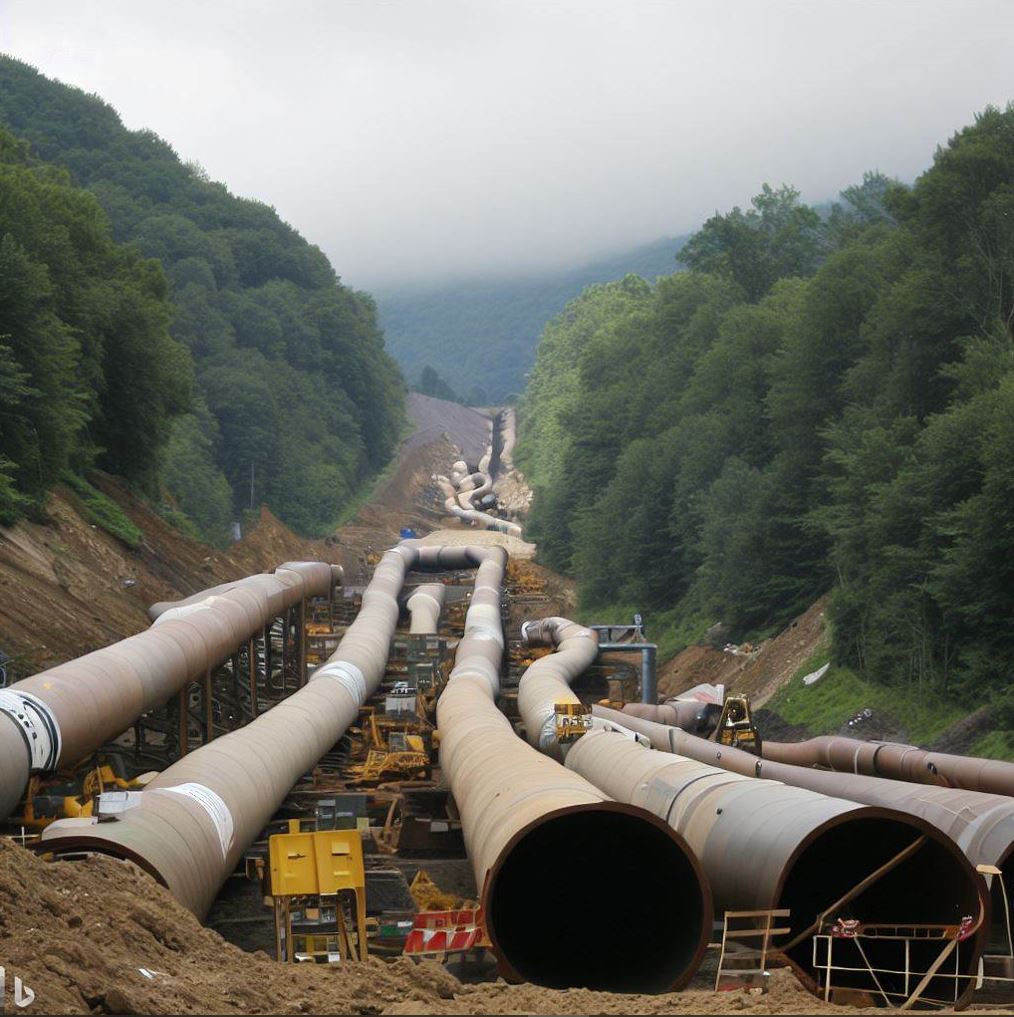
So let’s bang on the Mountain Valley Pipeline drum again, shall we?
I started following this project a few years ago, when West Virginia Senator Joe Manchin was holding up much of his own party’s legislative agenda to push a 300-mile natural gas pipeline through the Appalachian Mountains. The pipeline was unfinished, environmental groups were fighting it in court, and Manchin effectively turned his one Senate vote into a bargaining chip.
He got his pipeline.
The Mountain Valley Pipeline (MVP) began operating in June 2024, carrying shale gas from West Virginia into southern Virginia. Its estimated cost ballooned to nearly $8 billion, more than twice the original projection. Construction was repeatedly interrupted by legal challenges, frequently involving defective federal permits.
Congress came to the rescue in 2023, inserting a provision into the federal debt-ceiling agreement that Manchin would not approve of otherwise. The deal largely shielded the project from further judicial review.
When the courts become inconvenient, there’s always another way around them.
And the story continues. A separate 31-mile extension, called MVP Southgate, is now under construction to carry gas into North Carolina. It is scheduled to begin operating in 2028, and Duke Energy has committed to purchasing transportation capacity.
Why does this matter? Because the pipeline represents something much larger than a means of moving natural gas around. It is another example of extending the economic life of fossil fuels at precisely the moment we should be moving beyond them.
Consider West Virginia.
The state has a long relationship with coal, a resource that generated 87 percent of its electricity in 2025. Coal built its economy, employed generations of workers, and created enormous wealth. Unfortunately, most of the wealth flowed to the top, leaving many mining communities poor and vulnerable to the booms and busts of extractive industries.
Coal’s economic prospects have deteriorated to new lows. Aging power plants are more expensive to maintain while cleaner alternatives have been competitive for years. Utilities have been retiring coal-burning generators for years and replacing them with renewables, like 95% of new builds. It’s just smarter financially. There are occasional political attempts to revive the coal industry, but political enthusiasm doesn’t make an old power plant young again.
Fortunately, from the perspective of the extraction industry, West Virginia happens to be sitting atop another valuable resource: shale gas.
And there we have it. A new fuel, conveniently located under the old economic model.
Natural gas does offer some genuine advantages over coal. Modern gas-fired power plants emit roughly 60 percent less carbon dioxide per kilowatt-hour and far fewer other pollutants associated with coal combustion, such as mercury and sulfur dioxide. Closing coal plants also reduces the problem of coal ash, an unpleasant cocktail of contaminants left behind after combustion.
These are real improvements. But natural gas is still a fossil fuel. Worse, its principal component, methane, leaks a lot during production and transportation, eroding the climate benefits of replacing coal with gas. Even without leakage, burning natural gas still produces enormous quantities of carbon dioxide. In 2025, natural gas accounted for more than a third of all U.S. energy-related CO₂ emissions. So replacing coal with gas amounts to a partial improvement, with a potentially very long expiration date.
That brings us to North Carolina, where Duke Energy is pursuing precisely this transition.
At its Roxboro generating station in Person County, Duke is constructing two new natural gas combined-cycle units, each with approximately 1,360 megawatts of generating capacity. They are intended to replace the site’s coal-fired generators.
The language used on such projects makes it sound like a simple conversion, as though a utility techn ceremoniously turns a large dial on the wall from COAL to GAS.
What really happens is Duke tears down the old plant and builds new generating facilities. This is an enormous investment of equipment and supporting infrastructure, and it’s designed to operate for decades to recoup the investment and then some.
And that’s the part that troubles me.
A new gas plant may produce electricity more cleanly than the coal plant it replaced. But building one today commits ratepayers to another generation of fossil-fuel infrastructure, and emissions, even as cleaner technologies are proving to be the more practical move.
The economics are looking grim for fossil fuels. The International Renewable Energy Agency reports that more than 90 percent of utility-scale renewable projects commissioned worldwide in 2025 produced electricity more cheaply than the least expensive new fossil-fuel alternative in their respective markets.
In California, batteries charged with solar power are already displacing natural gas generation during evening peaks.
Duke argues that natural gas is needed to provide reliability as electricity demand grows. But the idea of reliability should prompt a rigorous comparison of alternatives, including costs over decades and exposure to fuel-price volatility. Sunshine, at least, will never deliver a fuel-price shock.
The availability of a new gas pipeline should not, by itself, determine which power plants get built, especially when pipeline operators and gas producers have their own long-term financial interests in keeping that fuel flowing.
There’s another issue here, one that has bothered me since I first began examining the project.
West Virginia’s dependence on resource extraction has left its working communities exposed to the fortunes of industries they cannot control. The state has valuable natural resources, capable workers, and considerable potential for new industries. What it needs is a diversified economy that can prosper without the fluctuations of a single commodity.
That means investing in education, infrastructure, manufacturing, technology, and industries with a future beyond the next deposit underground. Instead, the Mountain Valley Pipeline demonstrates a familiar proposition: extract another resource, build the infrastructure to sell it, and collect the proceeds for as long as the market and the public allow.
Joe Manchin argued that the pipeline was in the national interest. You could argue Congress ultimately agreed after months of bitter stonewalling.
And that may be the most revealing part of the story. A political agreement can declare a pipeline necessary, approve its construction, and remove legal obstacles. But it cannot make the underlying business model sustainable.
We are still spending billions extending the infrastructure of an industry whose decline is central to addressing climate change, even as cleaner, cheaper technologies make burning stuff for power look like an expensive, dirty habit.
West Virginia has been down this road before. Different fuel. Same dependency,